

Mind.Body.Fascia

It’s impossible to separate your mind from your body or vice versa. If you only nourish one, the other will suffer, and inevitably you will fall out of balance. Even trying to categorize mind vs. body becomes more difficult when you consider fascia and its role throughout the body. Far from the days when doctors would cut fascia willy-nilly, considering it nothing more than a binding tissue, we know better now. Fascia is the never-ending web that links everything together. Once thought to be void of any nerves, we now know that fascial tissues are one of the most innervated tissues in the body. Fascia contains both afferent and efferent nerves and receptors, communicating a vast amount of information. The pain you feel, how you move, strength, temperature, and even chemical changes are registered in your fascia and communicated to and interpreted by the brain. Understanding that treating fascia can help calm the nervous system offers a sense of hope for managing stress naturally. Why does this matter, you ask? It matters if you want to affect meaningful changes in your body. Perhaps you’re an office worker and spend most of your time sitting. You’ve tried meditation, but it doesn’t seem to help dull that feeling of anxiety, or like you always need to be doing something to feel valuable. Simply going to the gym or Pilates studio to bang out a workout won’t solve your problem. In our modern-day life, we require a more holistic approach. Treat the fascial tissue, and you treat the nervous system. This allows your tissues to respond to new movements, re-educating the muscles and posture and allowing the nervous system to move into a parasympathetic state where meditation and stress reduction are possible. The good news is that there is more than one way to get there. I use a variety of tools and movement modalities to treat fascia and help clients achieve the change they’re seeking.

When working with clients, I draw on my experience with Meditation, Qigong, Fascial Manipulation for humans and animals, Pilates, weight training, a dance background, and several external tools that the client can use, either guided by me or independently, to increase body awareness and release fascial tension. I encourage all my clients to explore meditation for stress reduction and general well-being. When welcome, I incorporate Qigong, sometimes as a warm-up, a full movement set, or drawing only on its principles.
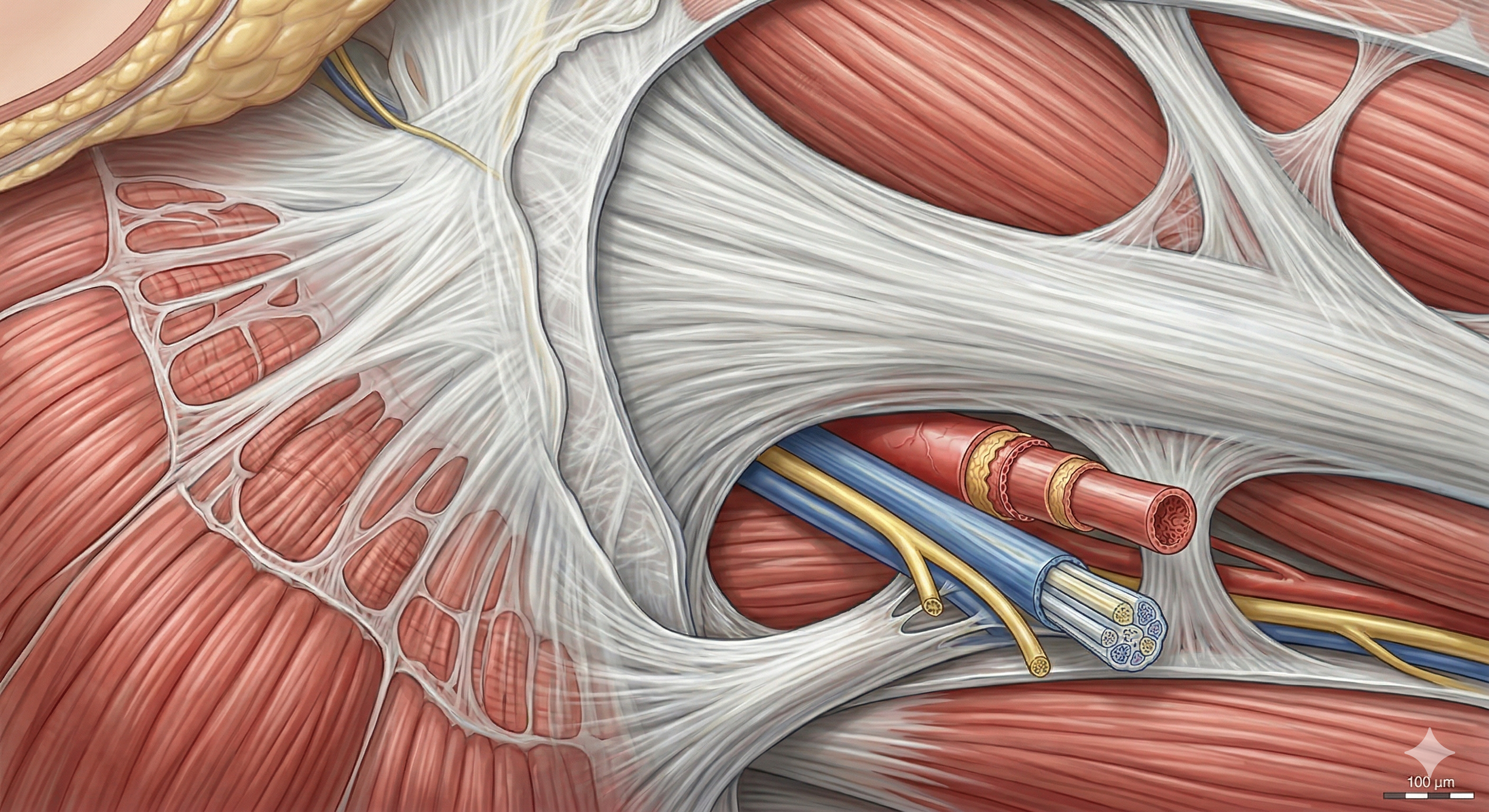
Healthy fascia
What is Fascial Manipulation?
Fascial Manipulation is a manual therapy method that focuses on the fascia, the connective tissue surrounding muscles, organs, and other structures, to improve mobility, reduce pain, and support overall well-being.
Luigi Stecco has developed the method over the past 50 years through careful study of anatomy, dissection and more than a dozen manual therapy techniques and philosophies. The method continues to evolve and is supported by more than 250 scientific studies. These studies expand understanding of the physiological reasons the FM system is effective, but many provide direct evidence of the method's effectiveness. The evolving picture of the fascial system continues to validate why FM works. The method is both logical and effective. Using the principles of FM and careful dissections and studies of animal fascial anatomy, two Finnish physiotherapists were able to translate the method for treating animals. Mainly dogs, horses, and cats, but can be adapted to any 4-legged companion animal.


Including fascial health as a priority in your overall wellness can make you feel empowered and motivated, as it is among the most consequential steps you can take for your long-term health. All the major muscles in the body are fascially continuous with the internal organs. Due to the nature of fascia and its role in our bodies, a change or injury to our Musculoskeletal system, whether via direct trauma or illness, can impact the normal functioning of our organs. The opposite is also true, where an injury or illness affecting the internal fascia will affect our musculoskeletal system. Nourishing fascia also requires adequate hydration and nutrition. A poor diet, especially a diet high in sugar, can weaken the fascial tissues.
Using modalities such as self-myofascial release, Qigong, or fascial manipulation can significantly impact your overall health, helping you feel more balanced and in control of your health, and enhancing your success in physical training and mindfulness practices.

Who benefits from FM?
Anyone experiencing movement dysfunction, chronic pain, or stress can find benefits from fascial manipulation. It effectively addresses biomechanical issues and, because of the fascia's interconnected nature, can also improve internal organ health, even when not directly targeted.
Equally, animals with movement dysfunction or even behaviour issues may benefit from the treatment. Though FM can be quite uncomfortable or even painful for humans, animals experience minimal discomfort during treatment, which dissipates within minutes of treatment initiation. This treatment can help prevent more invasive procedures and reduce overall costs, giving owners peace of mind about their animals' well-being. Animal Fascial Manipulation is NOT a replacement for Veterinary care, but rather an additional tool for owners to help maintain their animals' health and free movement.